
My Quick Verdict
After a week photographing arctic foxes in Hornstrandir, the Canon RF 200-800mm f/6.3-9 IS USM delivers a jaw-dropping 800mm of reach at a price that would have been unthinkable five years ago. The variable f/6.3-9 aperture is the only real compromise, and for most wildlife photographers it’s a worthwhile trade-off.
- Best For Wildlife Photographers On A Budget: Serious wildlife and bird shooters who need real super-telephoto reach without remortgaging the house.
- Skip If You Shoot In Low Light: The variable f/6.3-9 aperture means high ISO in dim conditions. If most of your work is dawn, dusk, or forest understorey, look elsewhere.
- One-Line Verdict: The most versatile super-telephoto zoom on the market today, at a remarkable price.
Disclaimer: some of the links in this article are affiliate links, which means I may earn a small commission if you buy through them, at no extra cost to you. As an Amazon Associate I earn from qualifying purchases.
The Arctic Fox has always held a special place in my heart. I absolutely love photographing them as they make for incredibly cute photography subjects. In 2025, I hosted the very first edition of my Arctic Foxes in Hornstrandir photo workshop, during which I set out with a group of photographers to focus on finding and photographing arctic foxes. It was an incredible experience to be out in one of the most remote corners of Iceland, with the arctic foxes being the only other living creatures inside of the valley we stayed in. It’s a huge learning experience for the workshop participants, who got to understand the habits of the arctic fox but also learned how to improve their wildlife photography.
And also for me it was a huge learning experience because during this photo workshop, I decided to try out the Canon RF 200-800mm F6.3-9 IS USM lens, which is one of the newer additions to Canon’s superzoom line-up. While I use zoom lenses a lot, I had never used a dedicated zoom lens with such a long range. I tested the Canon RF 200-800mm F6.3-9 IS USM for the entire week during the photo workshop in combination with a range of extenders and my Canon EOS R5 Mark II. How did I get one with it? You can find out in this review on the Canon RF 200-800mm F6.3-9 IS USM!
Interested in joining me on a future Arctic Fox adventure in Iceland? You can find current bookings on my Arctic Fox photography workshops page.
Full disclosure: This is not a sponsored review. I borrowed the Canon RF 200-800mm F6.3-9 IS USM for a week from Ofar/Canon Iceland and used it during my Arctic Foxes in Hornstrandir photo workshop. I am not being paid to write this review nor did anyone get any input or preview. All opinions are my own.

I almost exclusively used the Canon RF 200-800mm F6.3-9 IS USM during the entire Arctic Foxes in Hornstrandir photo workshop.

The weather wasn’t always ideal for the Canon RF 200-800mm F6.3-9 IS USM but I still kept using it to see it on all sides.
The lens came to me via a loan from Ófar/Canon Iceland. What follows is everything I learned about it after a week of intensive arctic fox photography: how it autofocuses, how the image stabilisation and sharpness hold up, what the extenders do, how the build survives in real weather, how it compares to my favourite wildlife lens, and the final verdict.
At A Glance: Canon RF 200-800mm f/6.3-9 IS USM Specs
| Spec | Value |
| Focal Length | 200-800mm |
| Maximum Aperture | f/6.3 (wide) to f/9 (long) |
| Mount | Canon RF |
| Image Stabilisation | 5.5 stops (claimed) |
| Minimum Focus Distance | 0.8m at 200mm / 3.3m at 800mm |
| Extender Compatibility | 1.4x and 2x |
| Filter Size | 95mm |
| Weight | ~2050g |
| Length | ~314mm retracted |
| Weather Sealing | Dust and moisture resistant (see notes) |
| Approx. Price | $2,149 USD |
What Is The Canon 200-800 Good For?
Short answer, after a week of arctic foxes in Hornstrandir: distant wildlife and birds, handheld, in decent light. The Canon 200-800 is the only RF zoom that reaches 800mm, and that single fact is why almost anyone buys it. It is sharp corner to corner in real-world use, the stabilisation never once felt like it was struggling across a full week shot entirely handheld with no tripod and no monopod, and on mammals the motors keep pace with whatever the body asks of them.
What it is less good for is anything fast or anything dim. Against the Canon RF 100-500mm L IS USM, the 200-800mm drives focus from near to far noticeably slower, and for birds in flight that shows up in your hit rate. At 800mm you are at f/9, roughly two thirds of a stop behind the 100-500mm at its own long end, and you pay that in ISO rather than in sharpness. One question decides the whole purchase: how often do you actually need more than 500mm? If the answer is most trips, the Canon 200-800 pays for itself the first week you take it somewhere good. If it is twice a year, rent it, or stay on the 100-500mm and crop.
Autofocus Performance: How The 200-800mm Handles Real Wildlife
Worth being precise about what “autofocus performance” actually means. Subject detection, Animal Eye AF, and tracking algorithms are all the camera body doing the work. What the lens contributes is its motor speed: how quickly it can drive focus from one distance to another.
On the Canon R5 and R5 Mark II, the body-side tracking on adult arctic foxes was very reliable. Animal Eye AF locked onto them almost every frame, and Servo AF held running subjects without drama. The 200-800mm’s motors kept pace with whatever the body asked of them.
The body-side AF did struggle in one specific situation: arctic fox cubs. The cubs’ eyes are tiny, and the eye colour is very close to the surrounding fur, so the animal subject detection sometimes couldn’t pick out the eye and defaulted to general body tracking. That’s not the lens, that’s the limit of current animal-eye detection. Switching to spot AF or eye-area AF on the cubs gave me a higher hit rate than trusting Animal Eye AF blindly. Worth knowing if you photograph fox cubs, puffin chicks, or anything else with low eye-to-fur contrast.
Where the lens itself can be directly judged is motor speed. In side-by-side use with the Canon RF 100-500mm L IS USM and the Canon RF 100-300mm f/2.8 L IS USM I had the week before, the 200-800mm’s motors were noticeably slower at driving focus from near to far. Not slow in absolute terms, just slower in direct comparison. For birds in flight, that motor speed difference will show up in your hit rate. For mammals and slower-changing focus distances, the 200-800mm motors are more than fast enough.
I didn’t see meaningful motor speed difference between 200mm and 800mm. Whatever penalty the lens pays for the variable aperture stays consistent across the zoom range.

When things are moving fast, such as this fox jumping over a river, the Canon RF 100-500mm clearly has an edge in autofocusing speed.
Image Stabilisation And Sharpness In The Field
Canon claims 5.5 stops of image stabilisation on the 200-800mm, and I have no reason to doubt that figure. I shoot wildlife with shutter speeds fast enough to freeze the subject anyway, so I can’t give you a slow-shutter handheld benchmark, but I never once felt the IS struggling on this lens. No micro-jitter, no IS slow to engage, no surprises. I shot the entire week handheld, no tripod, no monopod.
On sharpness, the 200-800mm is sharp corner to corner in real-world use. I’m not pixel-peeping centre versus edge crops here, but for actual wildlife photographs where the subject fills most of the frame and the corners are sky or out-of-focus background, sharpness is completely a non-issue. The lens stays consistent across the zoom range too; I didn’t notice 800mm being noticeably softer than 400mm or 200mm.
I didn’t notice any difference in colours compared to other Canon RF L glass I’ve used. I also didn’t see chromatic aberration, flare, or vignetting that I’d actually complain about in a real photograph. Anything visible was a two-second fix in post.
Using The Canon RF 1.4x And 2x Extenders
I used both the Canon RF 1.4x and 2x extenders with the 200-800mm during the workshop. The reach you can pull off with either of them is genuinely impressive: 1,120mm with the 1.4x, and a frankly absurd 1,600mm with the 2x.
The good news is that I didn’t notice meaningful image quality degradation with either extender attached. The lens stayed sharp, autofocus continued to work, and the rendering was consistent with the lens alone. That’s a credit to Canon’s optical design.
The bad news is the aperture cost. With the 1.4x extender, the long end drops to roughly f/13. With the 2x, you’re looking at around f/18. In Hornstrandir’s typical overcast light, that means cranking the ISO into uncomfortable territory or accepting much slower shutter speeds. If your subject is bright and your light is good, an extender turns the 200-800mm into a deeply specialised long-reach tool. If you’re shooting in low light, leave the extenders at home.
With the cubs, I tended to not use the extenders, because they were never too far away due to their curiosity in us. For the adult foxes hunting on open ground in better light, the bare 200-800mm was the right call.

With the extenders, you get even more range but you will have to rely on distance behind the subject to get some blur in your images.
Build, Handling, And Weather Sealing
This is the most surprising thing about the Canon RF 200-800mm: it feels light. Not “light for an 800mm” light, just light. Around 2 kilograms is well within all-day handheld territory, and balanced on the R5 or R5 Mark II it sits naturally. I never reached for a monopod, never felt fatigued in a way that compromised my shots. The zoom ring is smooth, the focus ring is smooth, and ergonomics are well thought through.
Canon markets the 200-800mm as having dust and moisture resistance roughly equivalent to their L-series lenses. In normal rainy Hornstrandir weather, it held up absolutely fine. I had no issues for several days of light to moderate rain.
The one caveat is that on one day, the rain in Hornstrandir went absolutely torrential. I pushed the lens hard, kept shooting in it for a couple of hours, and when I came back into the heated cabin afterwards the lens fogged up internally and needed time to dry out before it was usable again. The 100-500mm L, in the same conditions, has not done that on me before.
So calibrate accordingly. The 200-800mm is dust- and shower-resistant, and that’s enough for normal photography weather. It is not, in my experience, torrential rain proof in the same way an L-series lens is. Worth knowing if you photograph in genuinely extreme conditions.
One thing also worth flagging: the 200-800mm is not technically an L-series lens, despite Canon’s weather sealing claim, so you shouldn’t expect it to match the L-lineup on every front. The trade-off shows up here.

One day, it got really really wet which is when the little fox cubs look the most interesting I think but it also means you need super reliable gear if you stay outdoors.
Canon RF 200-800mm vs Canon RF 100-500mm L
This is the comparison most people reading this review actually care about, so let me be direct: I own the Canon RF 100-500mm L IS USM, I’ve used both lenses extensively, and the 100-500mm is still my favourite lens. If I could only own one wildlife lens, it would be the 100-500mm.
The 100-500mm is the better all-rounder. Faster autofocus, full L-grade weather sealing including a fluorine-coated front element and a more robust mount gasket, a slightly wider aperture range, and a body that’s noticeably lighter to carry over an all-day hike. For the kind of varied wildlife work I do, where one day is bird-in-flight and the next is mammals at distance and the day after is general landscape, the 100-500mm covers more bases.
What the 200-800mm has is reach. 300mm more reach at the long end, native, before any extenders. For dedicated long-reach work where you know you’re going to need 800mm, the 200-800mm is the right tool. For everything else, the 100-500mm wins.
One observation worth raising: more expensive lenses, like the Canon RF 800mm f/5.6 L IS USM, are optically and mechanically better than the 200-800mm. But they’re also a lot heavier. A heavy lens that you can’t comfortably hike around with is a lens that ends up not getting used. The 200-800mm is light enough that it actually makes it onto the trail, and that’s a real-world advantage no spec sheet captures.
Sample Images From Hornstrandir
All six images below were shot with the Canon RF 200-800mm during the arctic fox workshop in Hornstrandir, handheld, on either the Canon R5 or R5 Mark II. Click any image to open it in the lightbox.

Adult arctic fox at distance, where the 800mm reach is genuinely useful for keeping a respectful distance from wildlife.

Animal Eye AF on the Canon R5 Mark II locked onto the adult fox here without hesitation.

Sharpness at 800mm in real-world wildlife shooting, no pixel-peeping required.

The variable f/9 aperture at the long end means you commit to higher ISO in Hornstrandir’s overcast light, but the R5 and R5 Mark II handle that comfortably.

Fox cub close to the den. With cubs, Animal Eye AF occasionally lost the eye against the fur, so spot AF was sometimes the better choice.

Image stabilisation held the frame even with the long focal length, all handheld, no monopod.
What I Liked
- The Reach: 800mm native, before any extender, in a lens you can actually carry. Useful for ethical distance from wildlife and unique compositions you can’t get with a 500mm.
- Surprisingly Light: Around 2 kilograms, well balanced on an R5-sized body. All-day handheld is realistic.
- Reliable Autofocus: Animal Eye AF locked onto adult foxes almost every frame on both the R5 and R5 Mark II.
- Sharp Across The Zoom Range: Corner-to-corner sharpness in real-world use, consistent from 200mm to 800mm.
- Image Stabilisation That Stays Out Of The Way: 5.5 stops claimed, no quirks or surprises in a full week of handheld shooting.
- Extenders That Work: Both the 1.4x and 2x extenders mount cleanly with no obvious image quality penalty.
- The Price: Just over $2,000 for this much reach is genuinely remarkable.
What I Wish Was Better
- Weather Sealing Under Real Stress: Canon claims L-equivalent sealing, but in genuinely torrential rain the lens fogged up internally after a couple of hours. Fine for normal weather, less robust than the 100-500mm L in extreme conditions.
- The Variable Aperture: f/6.3 to f/9 is the cost of the reach and the price point. Workable, but if you shoot in low light you’ll be on high ISO often.
- AF With Small-Eyed Subjects: Animal Eye AF occasionally couldn’t lock onto fox cubs because of the low contrast between eye and fur. Spot AF is a useful fallback.
- Slower Than The L Glass: Autofocus is reliable but noticeably slower than the 100-500mm L or 100-300mm f/2.8 L in side-by-side use. Mammals: fine. Birds in flight: the L lenses will give you a higher hit rate.
- Not An L Lens: The build is solid, but it’s not on the same plane as Canon’s L-series glass. That’s fair given the price, but worth knowing.
Is The Canon RF 200-800mm Good In Low Light?
I had this lens in Hornstrandir in the middle of the Icelandic summer, when it barely gets dark at all. Low light was never what stood between me and the photograph, so I can’t give you a dawn-in-a-forest verdict I didn’t earn.
The maths doesn’t change, though. At 200mm you’re at f/6.3. At 800mm you’re at f/9, about two thirds of a stop behind the Canon RF 100-500mm L IS USM at its own long end. You pay that in ISO, not in sharpness.
So in forests or under a low winter sun, the body matters more than the lens. The Canon EOS R6 Mark III handles high ISO better than anything else I’ve used, and that’s what I’d reach for if the light were the problem. This is the trade for 800mm at this price. A 600mm f/4 doesn’t have it, and costs several times as much.
Final Verdict: Who Should Buy The Canon RF 200-800mm
The Canon RF 200-800mm f/6.3-9 IS USM is the most reach-for-money lens in the Canon RF lineup, and probably the most reach-for-money native autofocus lens on the market right now. A week in Hornstrandir convinced me that the 800mm long end is genuinely useful, that the build is light enough to actually use, and that the optics hold up to L-grade scrutiny in real photographs.
It is not, however, my first pick. The Canon RF 100-500mm L IS USM remains my favourite wildlife lens because it’s more versatile, faster to autofocus, more robustly weather sealed, and lighter still. If you only own one wildlife lens, the 100-500mm is the better choice.
But if you already have the 100-500mm and you want a complementary long-reach lens for the days when 500mm isn’t enough, or if you specifically photograph subjects that need every millimetre of focal length you can get, the 200-800mm is an easy recommendation. It costs roughly two thirds of what the 100-500mm L does while delivering 300mm more native reach. That maths is hard to argue with.
For workshop participants and travel photographers, my honest advice is this: heavier and more expensive lenses are often optically and mechanically better than the 200-800mm. But a lens you can’t carry comfortably on a multi-day hike is a lens that stays at home. The 200-800mm gets carried, it gets used, and it makes photographs that no smaller lens can.
If you want to try it in the field with my guidance, my Wildlife and Bird Workshops in Iceland are the easiest place to do that.
How Much Does The Canon RF 200-800mm Cost, And Is It Worth It?
Canon lists the Canon RF 200-800mm F6.3-9 IS USM at $2,149. It weighs 2050 grams and takes 95mm filters, so whatever polariser is in your bag right now almost certainly won’t fit.
The Canon RF 100-500mm L IS USM costs more and stops 300mm short. A 600mm f/4 costs several times as much and does one focal length. This is also the only RF zoom that reaches 800mm, which is really why anyone buys it.
Is it worth it? One question decides it: how often do you actually need more than 500mm? If the answer is most trips, it pays for itself the first week you take it somewhere good. If it’s twice a year, rent it, or stay on the 100-500mm and crop. Used is worth considering too, there’s no shutter count to worry about, just check the zoom ring for grit.
All of the testing above happened during one specific workshop: an arctic-fox-focused week in Hornstrandir Nature Reserve, where I had the Canon RF 200-800mm in hand from sunrise to sunset.
Photo Workshop Report: Arctic Foxes in Hornstrandir
In 2025, I hosted an arctic fox focused photo workshop in Hornstrandir for the very first time. While I have been to the Hornstrandir Nature Reserve on my own time, especially to photograph the arctic foxes, it was the first time I took one of my photography groups to the area. Hornstrandir is a challenging to run photography workshops as it is one of the most remote areas in Iceland, only reachable by boat. To get the best possible experience for the workshop, I organised for us to stay in a remote house in a part of the nature reserve that is not even frequented by hikers visiting the area.
Following a brief detour to focus on finding & photographing whales, we were dropped off on the beach at Kvíar, an old house, which would be our base of operations for the week. After settling in & getting familiar with the quaint house, we set out on a first reconnaissance hike. Not long after we set off, I began hearing an arctic fox calling. While the sound was initially very distant, the sound approached us slowly but surely. Sure enough, after staying put for a while, we spotted an adult fox running around an area filled with big boulders. The arctic fox wasn’t particularly interested in us as he/she seemed to be scavenging for food and ran higher & higher up the mountain doing so, giving us only a glimpse at the wildlife we were there to photograph.
But, little did we know, this was just a small taste of things to come…

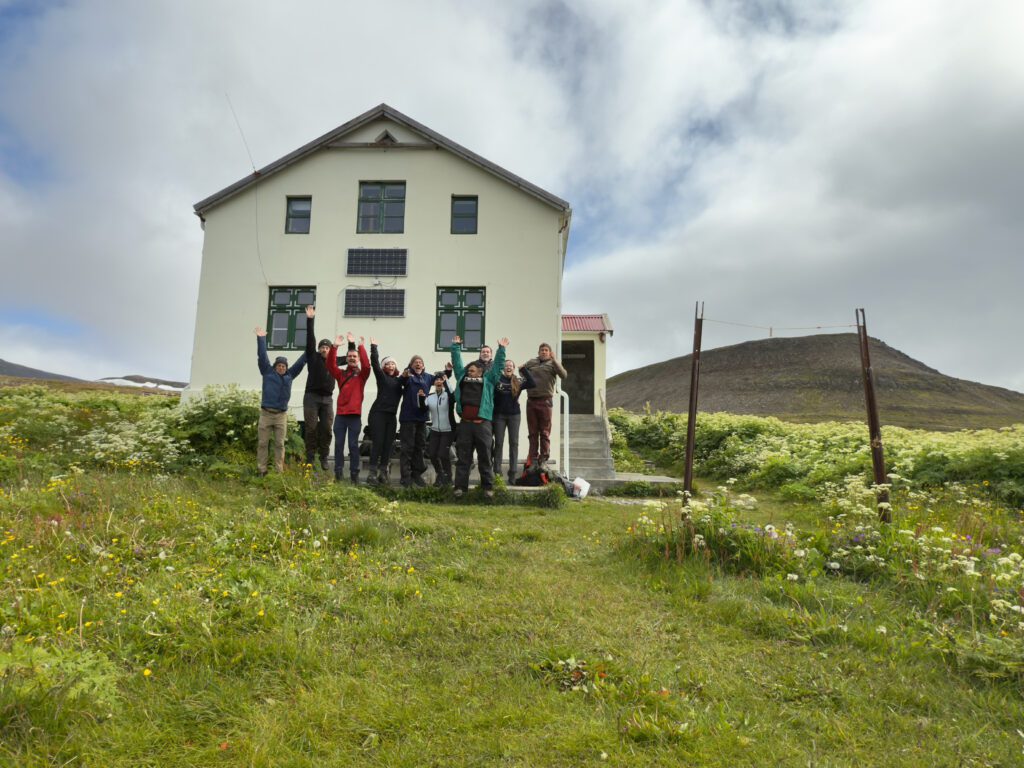
A great group of workshop participants on the last day of the photo workshop. Nothing but happy faces!

Our remote accommodation in a secluded valley, away from any other people in the entire Hornstrandir Nature Reserve.
The following days, things just got better & better as the photo workshop progressed. On our first full day, we started off with finding an arctic fox scavenging for clams & other juicy seafood on the beach down from our house. The arctic fox was completely indifferent of our presence and ran past us multiple times in search of food, allowing us to capture incredible close-up images.
Later that day, we began noticing a lot of arctic fox activity near the back of the house. At first it wasn’t so obvious but sure enough, we began seeing trails formed by the arctic foxes coming & going, indicating they had dug a huge den near the house. On the second day, after having gone through the daily image critique session, we were lucky enough to spot one of the arctic fox cubs sitting outside of its den. This cute little cub had become brave enough to venture outside of the safety of its den. It was amazing to think we were probably the first humans it ever laid eyes on.
And this newfound bravery quickly spiraled out of control. The next days, we began seeing more & more cubs exit the same den but they also began running around the house, becoming more & more playful. While we had always tried to keep our distance from the den and the cubs, to give them much needed space, the cubs themselves began approaching us to satisfy their curiosity. This evidently resulted in everyone getting incredible photographs of all these beautiful encounters.
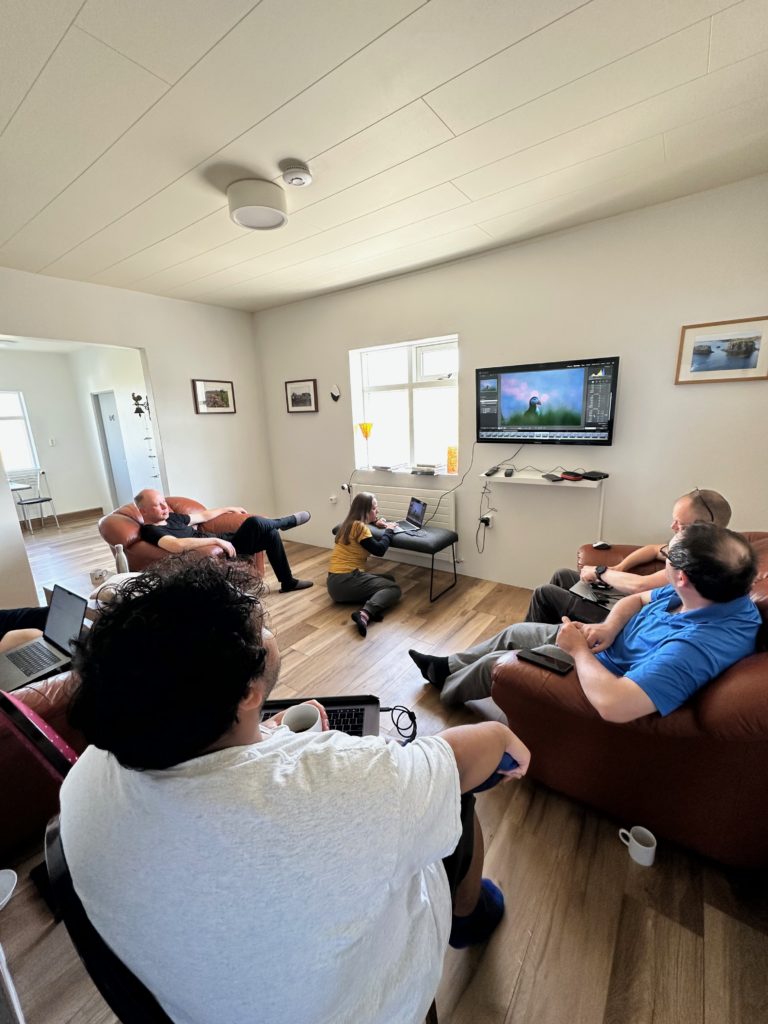
On top of all these amazing encounters, I enjoyed seeing how each participant dramatically improved their photographs & editing techniques thanks to the daily image critique sessions during this photo workshop. The whole purpose of these critique sessions, filled with helpful & constructive feedback, is to ensure everyone gets to go home with incredible images.

A dead giveaway that we are a group of photographers could be found at the charging station!

This old school stove wasn’t just used for cooking but also to keep our accommodation warm.
Shoot With Me
Put This Lens On Real Subjects
A long lens only proves itself in the field. On my Iceland, Greenland and Antarctica workshops we can shoot puffins on the cliffs, arctic fox at distance, penguins and seals from Zodiacs, and even orcas if we’re lucky. As small as possible groups, ethical fieldcraft, and the kind of patience that turns a decent lens into a portfolio.

Discover Jeroen’s Photo Workshops in Iceland, Greenland & Beyond
Ready to take your photography to the next level? Join me, Jeroen Van Nieuwenhove, on unforgettable photo workshops in Iceland, Greenland, Antarctica and other exciting destinations. Whether your passion is wildlife photography, bird photography, landscape adventures, or mastering drone photography, each workshop is designed to give you hands-on guidance in some of the world’s most spectacular locations.
From puffins in the midnight sun to Arctic foxes in the wild, from glaciers and volcanoes to dramatic coastlines seen by drone – these journeys are more than workshops; they’re once-in-a-lifetime experiences. Group sizes are kept small, ensuring personal mentoring and plenty of shooting opportunities.
Looking for something specific? Check out Jeroen’s…
- Wildlife & Bird Photography Workshops (Puffins, Arctic Foxes)
- Drone Photography Workshops
- Photo Workshops in Iceland
- Photo Workshops in Greenland
- Photo Workshops in Antarctica
Spots are limited – secure your place today!
Are You Looking For A Specific Photo Workshop?
All Upcoming Photography Workshops With Jeroen
Explore all upcoming photography workshops with Jeroen and take your skills to the next level in some of the world’s most extraordinary locations. From the volcanic landscapes of Iceland to the ice-filled fjords of Greenland and the wildlife-rich polar regions such as Antarctica, each workshop is designed to help you grow creatively while experiencing unforgettable moments in the field. Browse all upcoming departures below and find your next adventure!
LAST SPOT
LAST SPOTS
LAST SPOT
LAST SPOTS
OPEN FOR BOOKINGS
LAST SPOTS
WAITLIST
WAITLIST
WAITLIST
WAITLIST
WAITLIST
WAITLIST
WAITLIST
Where This Trip Goes Next
Every image in this review is from that June week, which means every fox in it is in summer coat. That is the trip I know. The other one, a white fox on snow in Hornstrandir, I have not done yet, and in February 2027 I am going back to do exactly that.
It is the same valley and the same house at Kvíar, in a season when the reserve is empty. Six places, eight days, 19 to 26 February 2027. If that is the version you want, it is the Arctic Foxes in Winter 2027 workshop. If you would rather have the cubs, that is the summer trip, and both of them sit on the Arctic fox workshops page. If you are planning your own trip instead, I have written a full guide to photographing Arctic foxes in Iceland.
What Previous Participants Shared About Their Experience
Choosing the right photography workshop is about more than just visiting iconic locations. It’s about experience, safety, timing, and personal guidance. Below you’ll find honest reviews from photographers who have joined me on landscape, wildlife & drone photo workshops in Iceland, Greenland and other locations. These testimonials reflect real experiences in small groups, hands-on instruction in challenging conditions, and the level of care Jeroen aims to bring to every workshop.
These reviews are verifiable on Jeroen’s public Google Business profile.


Support Jeroen’s Work
As an independent photographer, Jeroen partially relies on your support to keep producing worthwhile content such as blogs, photographs, books and much more. If you want to support his work, it is possible to do so by buying his e-books & books.
You can also sign up to the newsletter to stay up to date on new blog posts, projects, workshops and other interesting information.
Thank you for considering!