
The Short Version
Hornstrandir Nature Reserve in the Westfjords is where you go, and the only way in is by boat. Late June & July gives you cubs and brown summer coats. February & March gives you winter fur and snow. Only about a third of Iceland’s foxes turn white though, but a brown Arctic fox against snow is the more likely picture either way.
- Where: Hornstrandir. Uninhabited since the 1950s, and the only place in Iceland where the Arctic fox is completely protected from hunting. That’s the whole reason its foxes put up with us.
- When: Late June & July for the cubs. February & March for the white coat.
- Reach: Less than you think, at least with cubs. I shot a full week on a 200-800mm and left the extenders off most of the time.
- Getting in: Boat from Ísafjörður. No roads, no shops, no signal, and no popping back for the lens you forgot.
Interested in photographing Arctic foxes with me in Iceland? Current bookings are on my Arctic fox photography workshops page. The next one is Arctic Foxes in Winter 2027, eight days in Hornstrandir in February, six photographers only.
On our first full morning at Kvíar, an Arctic fox came down onto the beach to dig for clams and then ran past us so many times that we eventually stopped lifting the camera every time it did. Eight people standing on a beach in the middle of nowhere and it couldn’t have cared less. It had a mission: scavenging food.
That’s Hornstrandir. The Arctic fox has held a special place in my heart for years now, & that valley is the reason I keep going back.
Full disclosure before we go any further, because it changes how you should read the rest of this: that morning was in June. Every fox I’ve photographed in Hornstrandir has been a summer fox. Brown-coated, either working the beach or tumbling around outside a den.
I’ve photographed a white fox in full winter coat in Iceland. Once, somewhere else entirely, lying in deep snow, and it’s still one of my favourite images I’ve ever made. But a winter fox anywhere else in this country is one hard-won encounter you spend a whole day earning. Hornstrandir in winter is the concentrated version of that.
So this guide is two things at once. On the animal, and on summer in Hornstrandir, I’m telling you what I’ve seen with my own eyes. On Hornstrandir in winter I’m telling you what I’ve researched and what I’m planning around, and I’ll flag which is which as we go.
Grab a coffee (or a tea) and get comfortable, because this one runs long. Let’s dive in!

The beach fox at Kvíar, working the tideline on our very first morning. June 2025.
Where Can You Photograph Arctic Foxes In Iceland?
The Arctic fox is the only land mammal that was here before people were, and it lives across the whole country. That doesn’t mean you can photograph it across the whole country, and let’s be real, most people find that out the hard way. Most Icelandic foxes have learned, over a long and pretty unpleasant history with us, that the correct response to a human being is to leave.
The exception is Hornstrandir Nature Reserve, up in the far north-west of the Westfjords. Hornstrandir has been uninhabited since the 1950s and it’s the only place in Iceland where the Arctic fox is completely protected from hunting. The foxes there are dense on the ground & remarkably indifferent to people, and to me that’s the entire reason photographers go. These particular foxes, alone in the country, have never had a single reason to learn otherwise.
The other name you’ll run into is the Arctic Fox Centre in Súðavík, and let’s be clear about what it is, because people book whole trips around it by mistake. It’s a research centre and museum. There have been foxes in care there, but it’s not somewhere you go to photograph wild foxes doing wild fox things. A good stop if you’re already in the Westfjords and want to understand the animal. Not a substitute for Hornstrandir.
Foxes do turn up all over the country if you’re lucky and patient, and people get them in the Highlands and around the East. But if you’re travelling specifically to photograph Arctic foxes? You’re going to Hornstrandir.

A fox on the lichen above the fjord. This is most of what Hornstrandir looks like.
When Is The Best Time To Photograph Arctic Foxes In Iceland?
There’s no single answer here, because two completely different trips are hiding inside this question.
Late June & July is the cub season. This is the one I know first-hand. The cubs start coming out of the dens around the end of June, and by July they’re out in the open and getting bolder by the day. The adults are in summer coat, which is brown and, I’m not going to lie, far less striking than the winter one. What you get instead is behaviour: play, chasing, feeding, cubs working out what the world is. On the June 2025 workshop we found a den dug in behind the house we were staying in, and it went like this. Day two, one nervous little face at the entrance. Then two. Then, by the end of the week, a small gang of them running circles around the building while we tried to eat breakfast. It was amazing to think we were probably the first humans some of them had ever laid eyes on.

Two cubs outside the den behind the house at Kvíar. June 2025.

A blue morph cub. This one stays this colour all year, snow or no snow.
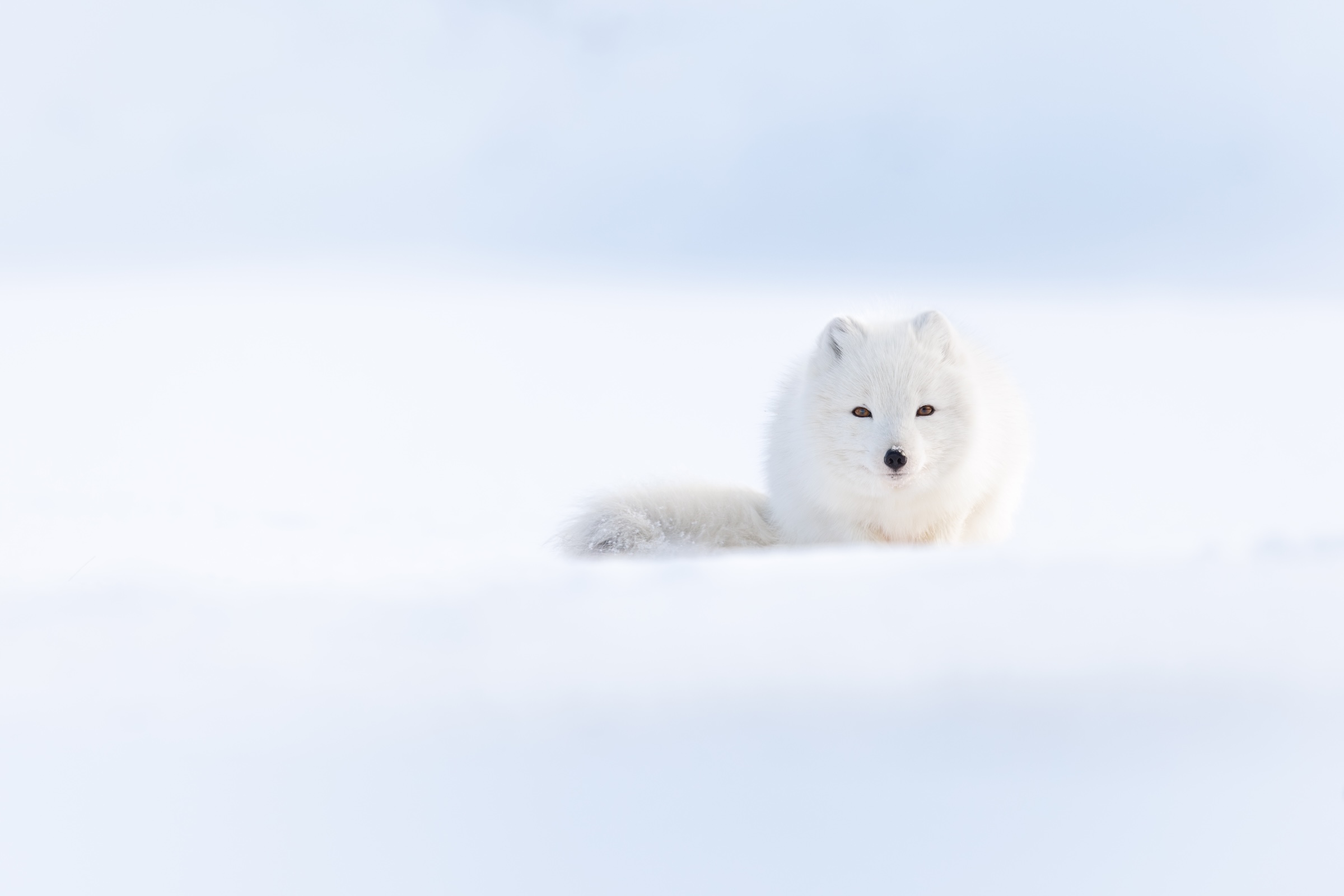
February & March is the white coat. Full winter fur, white ground, and light that stays low all day instead of for twenty minutes at each end of it. This is the picture that sells the species, and I get why. When you get it, the fox almost vanishes into the snow, and all you’re left focusing on is a black nose & two dark eyes.

A white fox in full winter coat, photographed in Iceland but not in Hornstrandir. This is what February is for.
Two things about doing that in Hornstrandir specifically I know from planning rather than from experience: the days are short, and getting in there in February is a genuinely different logistical problem to getting in during June.
One thing applies to both seasons though. Iceland’s Arctic foxes come in two colour forms. The white morph turns white in winter and brown in summer. The blue morph stays a smoky grey-brown all year round, and it’s unusually common here compared with the rest of the species’ range. Only about a third of Iceland’s foxes go white in winter. The other two thirds stay brown, and a brown fox on a snowy hillside is visible from a very long way off.
So even in February, are you guaranteed a white fox? No, you’re not. Statistically you’re more likely to be photographing a brown one on snow, and to me that’s its own kind of good.
What Time Of Day Are Arctic Foxes Active?
Less of a useful question here than it is almost anywhere else. Summer and winter break it in opposite directions.
In summer there’s no night. The sun doesn’t properly set in the north-west in late June, so the foxes aren’t working to a dawn-and-dusk schedule the way they might further south, and neither are you. On the June week we were photographing at hours that would be absurd anywhere else. What actually governed our day was the foxes’ own rhythm around the den & the tide on the beach. Not the clock.
In winter the problem flips. There are only a few hours of usable light in February, which is a constraint and also a gift, because all of it is the good stuff. That’s the plan, at least. Ask me in March 2027.
The practical version: don’t plan around a golden hour. Plan around being in the right valley for a very long time.

Low cloud, tall grass and one fox on a ridge. The light in Hornstrandir rarely does what the forecast says.
How Did The Arctic Fox Get To Iceland?
Nobody rowed it over. The generally accepted account is that Arctic foxes walked here across sea ice at the end of the last glacial period, which is also why it’s the only land mammal that beat us to the island. Everything else with four legs & fur arrived on a boat, on purpose or otherwise.
Small piece of trivia, but it changes how you look at the animal. When you’re watching a fox work a beach for clams in Hornstrandir, you’re watching the descendant of something that arrived on foot, over frozen sea, and then had the entire place to itself for thousands of years.

The shoreline its ancestors walked in on, give or take ten thousand years.
What Do Arctic Foxes Eat In Iceland?
Whatever’s going. That’s the short version, and it varies enormously depending on where the fox lives.
Coastal foxes, which is what you’re photographing in Hornstrandir, work the shoreline. The first fox we saw properly on that June trip was digging clams out of the beach, and it came back to do it again and again over the following days. They also take seabirds & eggs, and anything the sea leaves behind. Inland foxes have a harder time of it and rely much more on birds.
For a photographer this matters far more than it sounds, because it tells you where to stand. A coastal fox has a route. It works the same stretch of beach, it comes back at the same states of the tide, and once you’ve worked out that route you stop chasing and start waiting. That single realisation was worth more to us that week than any piece of equipment in our bags.

Same beach, same fox, same job. Work out the route and you stop chasing.
How Do You Actually Get To Hornstrandir?
By boat. That’s the only way in. There are no roads into the reserve and there’s nothing waiting for you when you arrive.
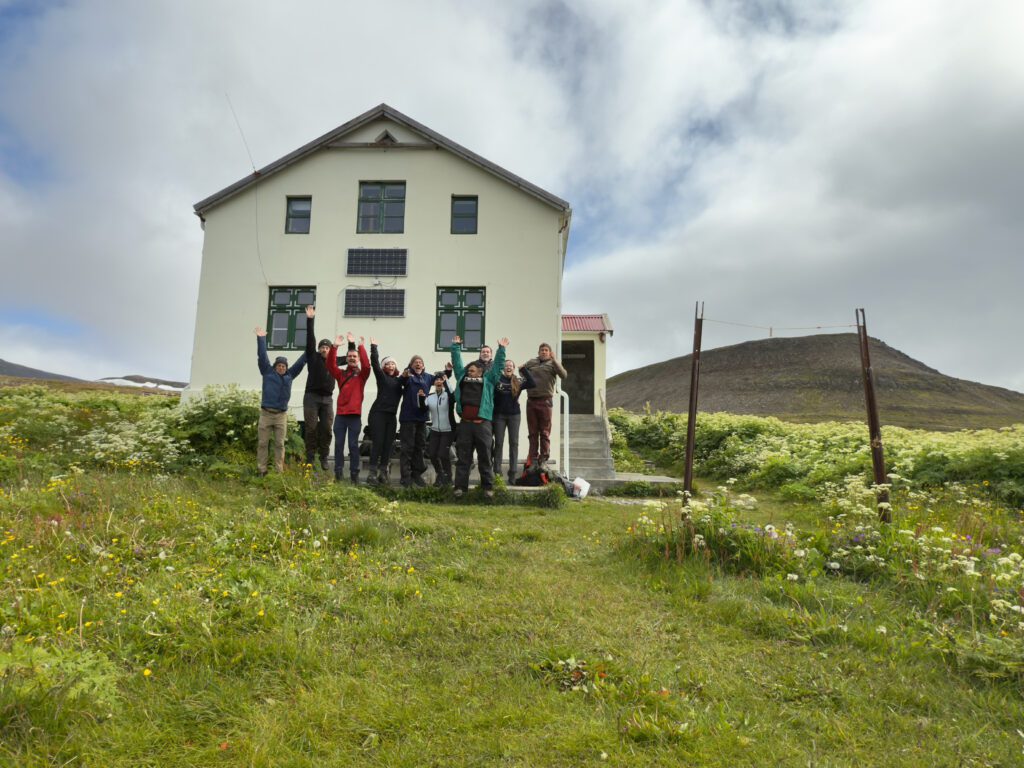
In summer, boats run from Ísafjörður and drop you on a beach. On the June workshop we came in via Kvíar, an old house in a valley that hikers don’t really pass through, and that house was our base for the week. It has a wood stove, which was not decorative. It’s also the only building for a long way in any direction.
Winter access is a harder proposition, a crossing of Ísafjarðardjúp rather than a summer beach drop, with weather that gets a vote. In my eyes that’s the single biggest reason there are so few winter fox trips compared with summer ones.
Whichever season, the thing to get your head around is that once you’re in, you’re in. No shops, no phone signal to speak of, no popping back for the lens you forgot. Pack accordingly and assume the weather will be worse than forecast on at least one day, because in June 2025 it absolutely was: we had a couple of hours of torrential rain, and my lens fogged up internally afterwards and needed a long spell in a warm room to come back to me.

Coming in to Hornstrandir by inflatable, June 2025. There’s no other way in.

Kvíar. Wood stove, no neighbours, and a fox den dug in round the back.
What Gear Do You Actually Need?
I’ll keep this short, because I’ve written a whole review about exactly this and there’s no point repeating it all here.
The headline is that you need less reach than you think, at least with cubs. I shot that entire June week with the Canon RF 200-800mm f/6.3-9 IS USM on loan, mostly handheld, no tripod and no monopod, and with the cubs I generally left the extenders off because they simply weren’t far enough away to need them. The extenders earned their place on adults out in the open. If you want the full breakdown, including where the autofocus struggled on cubs specifically (their eyes are tiny and almost exactly the same colour as the fur, which defeats animal eye detection more often than you’d expect), it’s all in my review of the RF 200-800mm from that week.
The one thing I’ll say twice: weather sealing isn’t a luxury item here, and neither is a plan for drying your gear out.

The RF 100-500mm after two hours of torrential rain. June 2025.
How Close Do They Get?
Closer than you’ll be ready for, and this is where the ethics of it start to matter.
On that June week we deliberately kept our distance from the den. That was the rule and we held to it. What we couldn’t control was the cubs deciding, somewhere around day three, that we were furniture. Not a threat, not interesting, just furniture. They started coming to us. There’s no camera setting for that and no way to prepare for it, and the honest answer to “how do you photograph a fox cub at four metres” is that mostly… you don’t. You put the long lens down and you watch.
And that’s the thing I’d most want you to take away from all of this. Hornstrandir’s foxes are relaxed because nothing has ever taught them not to be. That’s a fragile inheritance and it’s entirely possible for photographers to spend it. Keeping back from dens, not blocking a working route, and accepting that some days you get a distant fox on a hillside and that’s the day you had: to me, that’s the reason the place still works.
And to be clear about how these images were made: I don’t bait. No food put out, no scraps, no carcass dragged into good light to hold a fox in place. Every fox in this piece turned up because it lives there and because we waited. I’m not going to lecture anyone about it. But you’re looking at my pictures, so you should know how they were made, and if you’re booking a fox trip with anybody, it’s a fair thing to ask.

Day three, and roughly the distance at which the long lens stops being any use at all.

And this is what happens once they stop caring that you’re there at all.
Going Back In Winter
Everything above about summer in Hornstrandir, I’ve lived. Hornstrandir in winter, I haven’t. In February 2027 I’m taking a group of six in there, staying at Kvíar, and finding out what that valley looks like when it’s frozen and empty and the foxes have changed coat. I’m not going to pretend I know what that’ll be like, because I don’t.
What I do know is why I picked it. Winter is the only time the animal looks the way it does in everyone’s head. Hornstrandir is empty in a way it never is in summer. And six people can move quietly through fox territory in a way that twelve simply cannot.
If you want to come along, it’s here. If you’d rather have the cubs, that’s a different trip and a very different experience, and both of them sit on the Arctic fox workshops page.
And if you’re going on your own: go to Hornstrandir, give yourself far more days than you think you need, and let the fox come to you. It usually does.
Frequently Asked Questions
Where Is The Best Place To See Arctic Foxes In Iceland?
Hornstrandir Nature Reserve, in the far north-west of the Westfjords. The reserve has been uninhabited since the 1950s and is the only place in Iceland where the Arctic fox is completely protected from hunting, so the foxes there are unusually relaxed around people. The Arctic Fox Centre in Súðavík is a research centre and museum rather than a place to photograph wild foxes.
When Is The Best Time To Photograph Arctic Foxes In Iceland?
Depends which picture you want. Late June and July is cub season, when the young foxes are out of the dens and the adults are in brown summer coat. February and March is when the foxes are in full winter fur and the ground is white.
Are Arctic Foxes In Iceland White?
Most aren’t. Only about a third of Iceland’s Arctic foxes turn white in winter. The other two thirds are the blue morph, which stays a smoky grey-brown all year round and is unusually common in Iceland compared with the rest of the species’ range. In summer, neither form is white.
Do Photographers Bait Arctic Foxes In Iceland?
Some do. Putting food out will hold a fox at a predictable distance in predictable light, which is exactly why it happens. I don’t bait, and it’s a fair thing to ask any photographer or operator before you book with them.
How Did The Arctic Fox Get To Iceland?
The generally accepted account is that Arctic foxes crossed to Iceland over sea ice at the end of the last glacial period. It’s the only land mammal that was here before people were.
What Do Arctic Foxes Eat In Iceland?
Coastal foxes work the shoreline for clams, seabirds, eggs and whatever the sea leaves behind. Inland foxes rely much more heavily on birds. Coastal foxes tend to work the same stretch of beach repeatedly, which is useful to know if you’re photographing them.
How Do You Get To Hornstrandir?
By boat only. There are no roads into the reserve. Summer crossings run from Ísafjörður and drop you on a beach; winter access is a harder crossing of Ísafjarðardjúp and is much more weather-dependent.
Shoot With Me
Photograph Arctic Foxes With Me In Hornstrandir
Everything above came out of one week at Kvíar. If you want to do it yourself, I take small groups into Hornstrandir in both seasons: cubs and summer flowers in late June and July, full winter coats and snow in February. Small groups, no baiting, and as much time in one valley as the weather allows.
What Previous Participants Shared About Their Experience
Choosing the right photography workshop is about more than just visiting iconic locations. It’s about experience, safety, timing, and personal guidance. Below you’ll find honest reviews from photographers who have joined me on landscape, wildlife & drone photo workshops in Iceland, Greenland and other locations. These testimonials reflect real experiences in small groups, hands-on instruction in challenging conditions, and the level of care Jeroen aims to bring to every workshop.
These reviews are verifiable on Jeroen’s public Google Business profile.


Support Jeroen’s Work
As an independent photographer, Jeroen partially relies on your support to keep producing worthwhile content such as blogs, photographs, books and much more. If you want to support his work, it is possible to do so by buying his e-books & books or prints.
You can also sign up to the newsletter to stay up to date on new blog posts, projects, workshops and other interesting information.
Thank you for considering!